Wednesday, July 13, 2011

Illumination

Hello everyone. I have not posted here in awhile and so I thought I would offer a poem I composed in February concerning my belief that a sustainable existence with the natural environment and personal growth can both be achieved without one dominating the other. I developed a film around the poem as well which I invite you all to experience. It can be seen at my Youtube channel address which is www.youtube.com/user/joshuacallentown

I hope you all are well.

Illumination

I stood on a rock
in a field of grass and apple trees.
I was called to this spot,
called to stand there
and watch the clouds move
and the limbs
and to sense the earth turning.

I came here for direction,
that I might receive it
and that I might offer it.
What fire will I gift to the world?
What seed for the growing infertile?

I stepped down from the rock
and I was freezing.
I will walk to the creek,
I thought.

I imagined a human being
careful and deliberate
walking through these woods.
Fulfilled without imbalance.
Existence without harm.
With knowledge of the natural world,
its healing powers and abundance.
Communicating with all things.
Genius, green and growing.
Strong, enraptured and naked.
The care and the caretaker.
Concentrating the will toward illumination
and progress alone.

Seeing the water
I sat down and said to myself,
"We can be as beautiful as we want to be."

Monday, April 4, 2011

The Girl With the Dragon Tattoo

The Girl With the Dragon Tattoo, by Stieg Larsson begins by introducing us to Mikael Blomkvist a financial investigative journalist. He has been sentenced to serve 3 months jail time and a monetary fine for libel against a crooked billionaire, Hans-Erik Wennerstrom. Before he begins his jail sentence he is approached by a Henrik Vanger to research the death of his niece who has been missing for 40 years. Vanger offers Blomkvist a large sum of money and tells him he has a year to figure out the mystery of what happened to his niece, Harriet Vanger. After the year Vanger says he will provide Blomkvist with the necessary information to take down Hans-Erik Wennerstrom.


The novel also follows the life of Lisbeth Salander, a tattooed and pierced young women whom he tracks down after discovering she had hacked into his computer. Lisbeth is tough as nails and takes no crap form anyone, despite appearing mentally handicapped. If you wrong her you better watch out, she will get revenge. With Lisbeth's help he begins to uncover more that just the mystery of one young girls disappearance.


After reading this book I saw that the original title was Men Who Hate Women, which I think would have been much more appropriate. Throughout the book there is violence, often sexual, against women, which turns out to be a recurring theme in the book. The book also gives statistic's on violent acts commited against women in Sweden. It made me very glad I don't live in Sweden.


The beginning of the book gets off to a slow start, but after getting through all the initial background on Blomkvist and Lisbeth the story really gets interesting. At times it is difficult to keep track of all the members of the Vanger family. I think a family tree outline would have been helpful, but overall it was a very good read and I am planning on reading the next two books in the series.

Thursday, March 31, 2011

Limerick Laughs Submission

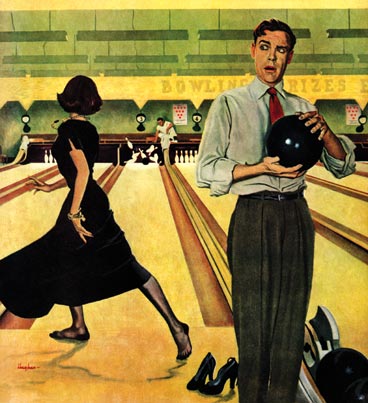
My submission for the Saturday Evening Post limerick contest Aunt Sue told us about.  Click here for contest details.

Caught off guard as the pins crack and tumble.
In those stockings she surely would fumble.
She kept me unaware,
I thought maybe a spare.
Smile, nod, and try not to grumble.

Friday, March 18, 2011

Writer-Bite: Limerick Contest!

The Saturday Evening Post is sponsoring a limerick contest, awarding $100 for the limerick judged to be the best fit for this bowling image. Your entry must be postmarked by April 4th!

Friday, March 11, 2011

Thanks for The Memory !

The Academy Award for Best Original Song of 1938 went to Thanks for the Memory, which was adapted many times over as it evolved as Bob Hope's personal theme song. Here's an adaptation I was inspired to write after spending a magical evening in Chicago. If you were there and want to add a stanza, feel free! If not, write your own adaptation as a March mini-challenge! For inspiration, see this video clip from The Big Broadcast of 1938 on YouTube here.

Thanks for The Oscars Dinner Party Memory

Thanks for The Oscars memory
Street-wise Daniel parked Mom’s car, Ball canning jar décor
Ikea world-wide wall map, gleaming oaken hardwood floors
How lovely it was!

Thanks for the memory
Of Michelle taking fashion notes, of category votes
PG had the early lead, as we all harbored secret hopes!
How lovely it was!

Many’s the time we were laughing
And many’s the time we were grinners
(Or groaners!) As we tried guessing the winners
Oh, to experience such ambiance!

And thanks for the memory
Of Paul’s java brewed just right, pick-a-cup delight
Fresh pasta Mia’s way set the stage for a perfect night!
So, thank you so much!

Thanks for the memory
Talk of romance books and, of red carpet looks
TC was Country Strong, but Randy won it with his hook
How lovely it was!

Thanks for the memory
Of Uncle Lee on eBay, (vintage postcards on the way . . .)
Thanks for treating us like treasure is what we want to say!
How lovely it was!

Where else would Division unite us
And where else would we raise a nice toast
To Chicago’s most award-winning hosts
We did have fun! The King’s Speech won!

So, thanks for the memory
Of Best Actress Natalie, of choppin’ broccoli
This 83rd Annual Academy Awards party is now part of history!
And thank you so much!

Wednesday, March 9, 2011

An Object of Beauty: Chapter 53, I Wink to Thee!

For me, the masterpiece of An Object of Beauty is comprised of all the words contained in Chapter 53! Reminding me of a memorable holiday dinner get-together or a stimulating version of Table Talk, this restaurant-gathering depiction ranks in my top three of Best Book Chapters Ever. Before I got a copy of this book, I listened to an audio version, and Campbell Scott’s voice told this tale well. In fact, it was only in Chapter 53 that I thought that I specifically ‘heard’ author Steve Martin’s voice come through with distinct enunciation when the name of Hollywood actor ‘Stirling Quince’ was announced. I can imagine that Steve might have even winked upon saying those two words, which his main character of Lacey Yeager would have frowned upon.

Can you imagine what would have happened if, when flutterby posted the Ditalini Press 'Just Dialog' Challenge, she stipulated that we include fifteen character voices? This is why Chapter 53 is suitable for framing: it debates, from so many personal-perspectives, the merits of art, with Lacey’s journalist friend Daniel inserting just the right questions to keep the conversation lively. I am reminded of the great Michael Zinman who challenges us to collect – pick something, anything and just collect! (If you don’t like to collect ‘stuff’, try collecting memory images and hang them on a clothesline display in front of your Third Eye!) This group happens to collect art! As one might surmise, Mr. Martin is also quite the art collector, and in 2001 wrote a book about his collection, Kindly Lent Their Owner: the Private Collection of Steve Martin, which is listed on his website, www.stevemartin.com. A new copy can be had for a mere $400.00 through Amazon, a used copy from $95.00.

But I digress!

Lacey’s voice is surprisingly silent in Chapter 53. This particular art crowd at this particular time must not have suited her purposes or, rather, been able to further her purposes. Instead, at the end of the chapter Daniel spots her keeping cozy with a Russian playboy art collector, at a table for two. Described as ‘reckless’ in the book, I would add ‘ruthless’ to the description of Lacey and her most unscrupulous act is the one on which this book hinges. For as Lacey navigates the ins and outs and around and abouts of the art world, objects of beauty soon take on value-added dimensions, allowing her to deliberately up-style her life, but will she be truly liberated?

At first glance, what attracted me to this book were the art reproductions. Once reading, I loved the dappled light that played with similes throughout, and the rays that occasionally glinted off of rare golden chiasmus nuggets. When that happened, I might have even winked - in defiance of Lacey and in deference to the enlightened, word-smart geniusness of Stephen Glenn Martin!

Curiously, it is in Chapter 53, so full of art appreciation dialog, that we are let in on the secret of engaging in dialog with Art itself. So the next time an object of beauty gets your attention, whispering soft promises or all but shouting: Stop. Linger. Listen.

Monday, February 28, 2011

You better run, squirrel!

I'm not really a fan of New Year's resolutions, but I have to admit, they do motivate me.  Last year, I participated in the Haynes Apperson Festival four-mile run in July.  I would like to say I ran it, but I did quite a bit more walking than running.  My resolution for this year is to participate in the Haynes Apperson and run the whole four miles.  I guess it may be more of a goal than a resolution.

Running has always intimidated me, and I think my struggles with it were more mental than physical.  I have to admit that I am growing to enjoy it; especially running outside as opposed to on the treadmill.  I still have a long way to go before I can run a solid four mile stretch, but no one said New Year's resolutions are supposed to be easy!

So What'd You Think of An object of Beauty....?


I’ve been twice to the International Basel Art Show which takes place every June in Switzerland and have witnessed dapper gentleman in houndstooth buying paintings by Hans Arp for $20,000 and overheard many an avant-guard nabob negotiate superior sums on their cell phones. I’d wondered who these people were, what kinds of lives they lived. In Steve Martin’s latest novel, An Object of Beauty I was given some insight into this world of art that fascinates.


The book’s main character is Lacey as described by a nerdy and likable narrator, a writer for ARTnews. She is an enviable femme fatale type: attractive, witty, appreciator of and surrounded by the finest of worldly things, driven by intense amition to succeed, ensnaring millionaire art dealers in her charms, moving free of self-doubt or timidity. I think Lacey’s complexities reveal Martin’s understanding of women in general.


When Lacey sells her Grandmother’s Maxfield Parrish painting in a dubious way in order to stay in New York and pursue her dream, readers see just how unscrupulous, almost immoral she is. Especially when said Parrish painting depicts her own grandmother as an enchanting youth, a dear testament to an ongoing familial link to art, artists, and to beauty. This ambitious move renders her shallow, vacuous, as the New York art scene seems after the terrorist attacts of September 11.


I found the book to be a fun and rollicking read while maintaining an intelligent tone. I think it would adapt well to film. It is also, most importantly, powerful in conveying art’s inherent value to humanity. This was aided by the twenty-two reproductions of various artworks found throughout and especially felt from one effectual scene in which Lacey hangs a painting by Milton Avery on her apartment wall. Readers witness the Avery catalyzing an almost spiritual transformation of her apartment, turning it from a student-like, juevenile space to a harmonious, exquisite, mature abode. She has a revelation at this moment, understanding why people collect art, value it, invest in it.


It would be hard not to come away unaffected by An Object of Beauty. It seems likely that readers of every kind will have a new or refreshed understanding of art, even be stirred to collect or investigate it further.


It’s impassioned author said shortly after buying a painting by William Michael Harnett, a 19th century still-life painting (from New York Times article November, 2010): “It’s absolutely great to live with. It’s better than television. There’s not a day I don’t look at or spend some amount of time with an artwork.”

Sunday, February 27, 2011

My Thoughts on An Object of Beauty

I am not at all familiar with the world of art that extends beyond my children's drawings that hang on my refrigerator, so reading An Object of Beauty was a learning experience for me. Because I know very little about art and the culture surrounding it, at times I found myself wanting to skim through the descriptions of the works of art that are throughout the book, but I persevered and learned that while I may not understand what makes a person want to spend thousands of dollars on a piece of art I can respect that they do.

The main character's personality and story are what really kept me interested in this book. To me it seems the main character, Lacey Yeager, uses any means necessary to work her way up in the art world from a clerk in the basement of Sotheby's to eventually owning her own gallery. Her relationship's with people more often than not revolved around what a person can do for her and her career than her actually being a friend. I found the stories of her escapades much more interesting than the descriptions of the various work of art she comes across. I often found myself wanting to like her, but never really being able to.

I enjoyed reading An Object of Beauty because it made me look at another slice of the world. Although I will probably always be someone who takes a quick look at a painting and then moves on to the next, I will remember that while I take it for what it is, there is always a different way to see it. I learned that while it may just look like a painting of a field there is always more than what meets the eye. All you have to do is look.

Friday, February 18, 2011

Childhood Home for Sale

vineyard walk II
After dancing around it like a maypole, you and I sat in its shadows, laughing, squishing the translucent, gooey grapes into our mouths, throwing the dark paper skins into the summer sky, spitting the seeds.   It was just a season or two after dad trimmed it too much and we thought it would certainnly die that we ate its grapes with our eyes on mom and dad, hoping they both tasted sweetness at the same time.  
We picked colanders full of the concord grapes and brought them inside, some cracked with juices attracting fruit flies.  
In late August, brown with sun, hair stiff from pool water,  we’d slip around back to see if the grapes were ripe.  We’d part the branches, crawl under the weighted arbor, where bunches hung free among spiders.  Handfuls of gummy sweetness into our mouthes, we strewed seeds around us, giggling, chewing gemmy morsels.
This Victorian grapevine that someone planted long ago, that survived the tornado of ’69, gave us so many seasons of fruit.  Even when the Japanese beetles seemed to stir its every leaf, even when the neighborhood kids picked and threw so many grapes at each other rather than eat them,  there was always enough.
One year mom made a circular garden and dad planted an apple tree beside that grapevine.  The apple tree matured and gave bitter, hideous, bulbous fruit.  The ciruclar garden was overgrown with weeds, torn up, and hissing, mutilated, inbred cats crept in.
The vine was just out of view from our childhood bedroom window.  We grew up,  it grew dense, neglected, like a forgotten elder.   The fertile field behind our house became pre-fabricated, chem-lawned home plots.  A floodlit parking lot replaced the restful darkness of night.